
Search behavior has changed dramatically.
People no longer rely only on traditional Google searches to find products, services, companies, and answers. They increasingly interact with AI-powered search experiences, conversational tools, voice search, and other answer-oriented platforms.
For businesses, this creates a new challenge: How do you make your brand visible across traditional search and AI-driven discovery while generating measurable business results?
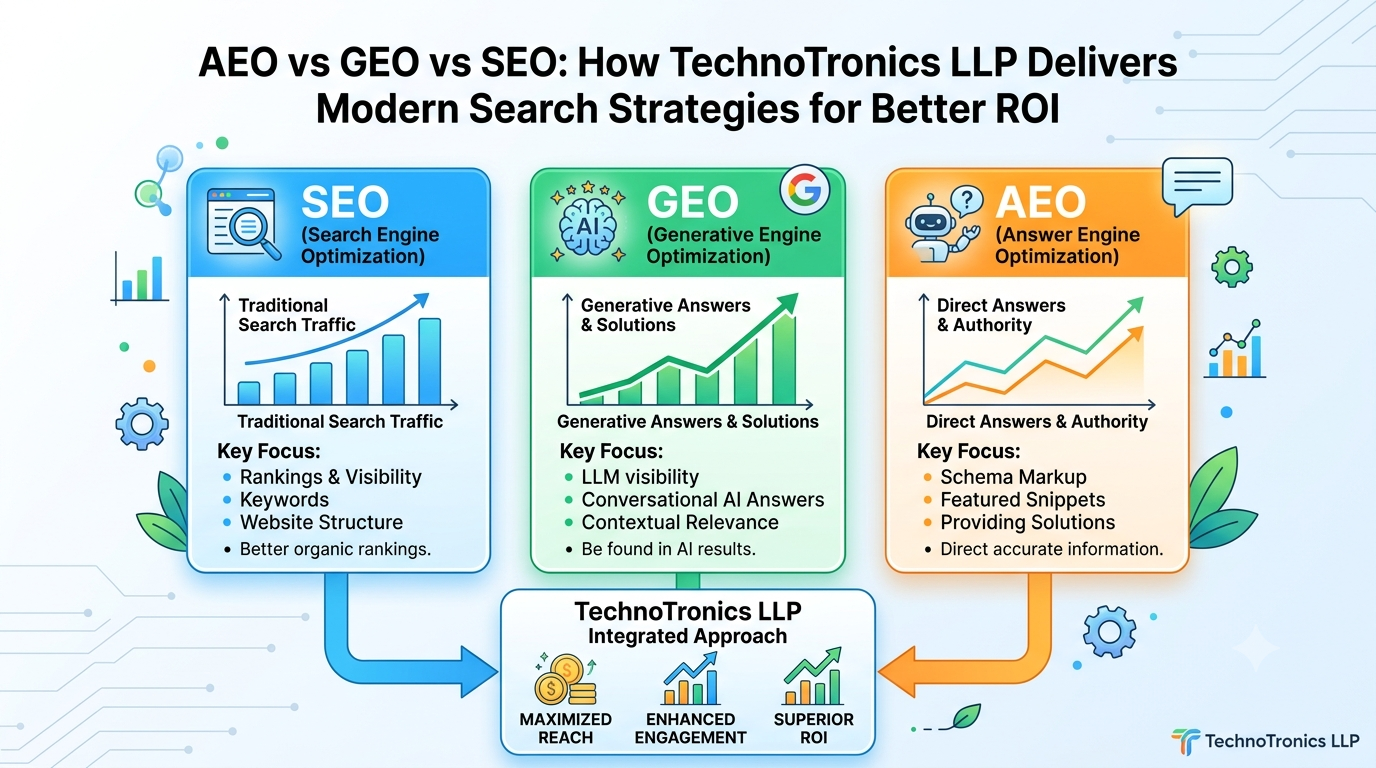
At TechnoTronics, we approach this challenge by bringing SEO, Answer Engine Optimization (AEO), Generative Engine Optimization (GEO), technical optimization, content strategy, and performance measurement together into one integrated digital strategy.
Rather than treating SEO, AEO, and GEO as completely separate services, we use them as complementary components of a modern search marketing framework.
The objective is straightforward:
Improve visibility → attract relevant users → build trust → generate qualified leads → improve conversions → measure business ROI.
How Does TechnoTronics Approach Modern Search Optimization?
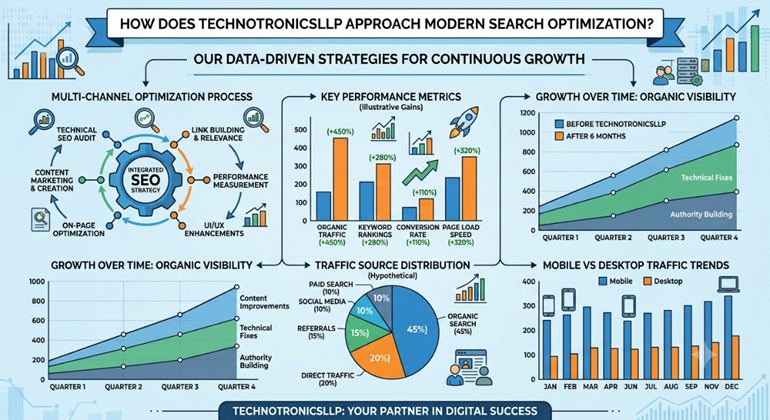
Our approach begins with a simple principle: search optimization should support business objectives, not just rankings.
A business may rank for hundreds of keywords and still generate limited revenue if those keywords have poor commercial intent.
Therefore, our SEO services begin by understanding the client’s:
-
- Business model
-
- Target audience
-
- Products and services
-
- Geographic markets
-
- Competitors
-
- Customer journey
-
- Conversion goals
-
- Existing organic performance
-
- Revenue priorities
We then develop a customized SEO strategy around those factors.
This allows our team to prioritize keywords, content, technical improvements, and authority-building activities that have a logical relationship with business growth.
Our approach can be summarized as:
Business Goals → Search Data → Strategy → Execution → Measurement → Optimization
That framework keeps SEO connected to ROI rather than treating it as an isolated marketing activity.
How Do We Use SEO as the Foundation?
Traditional search engine optimization remains the foundation of our methodology.
Before focusing heavily on AEO or GEO, we ensure that the underlying website is accessible, technically sound, relevant, and structured logically.
Our technical SEO process can examine areas such as:
-
- Crawlability
-
- Indexation
-
- Site architecture
-
- Internal linking
-
- Page speed and performance
-
- Mobile experience
-
- Metadata
-
- Canonicalization
-
- Broken links
-
- Redirects
-
- XML sitemaps
-
- Structured data
-
- Duplicate content
-
- Core Web Vitals
Why is this important?
Because advanced content strategies cannot compensate for fundamental technical problems.
We therefore use technical SEO to create a strong foundation on which content, AEO, GEO, and authority strategies can operate.
How Does TechnoTronics Conduct Keyword Research?
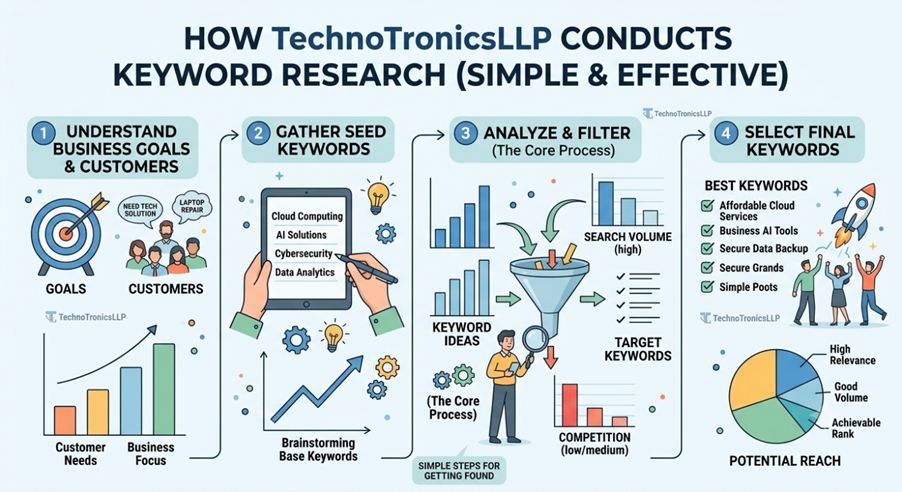
Effective keyword research is more than collecting keywords with high search volume.
Our process considers several dimensions:
Search volume
How frequently is the topic searched?
Competition
How difficult may it be to achieve meaningful visibility?
Search intent
Is the user researching, comparing, purchasing, or looking for a specific service?
Business relevance
Does the topic relate directly to the client’s products or services?
Conversion potential
Can the search potentially lead to a meaningful business action?
Semantic relationships
What related questions and topics surround the primary keyword?
For example, instead of targeting only a broad term such as SEO company, we can map supporting searches around SEO services, technical SEO, local SEO, SEO strategy, keyword research, content optimization, SEO pricing, and related questions.
This creates a broader topical ecosystem.
How Do We Integrate AEO Into Client SEO Strategies?
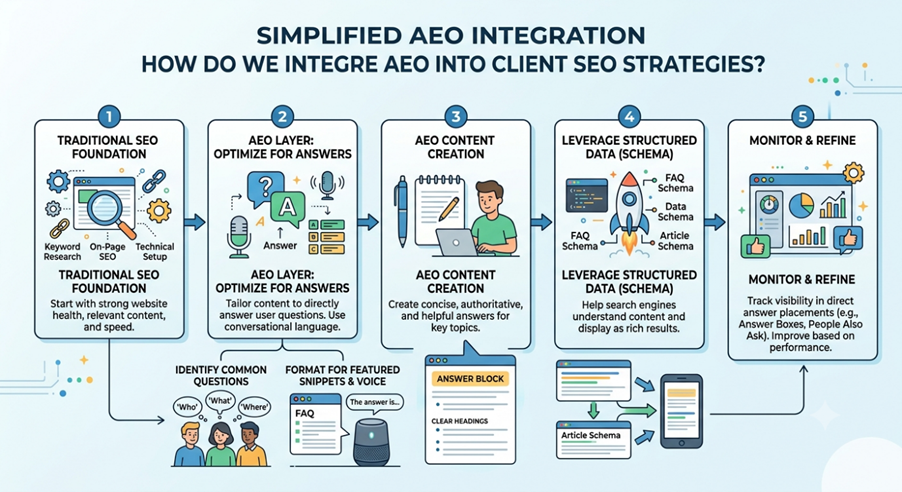
Answer Engine Optimization (AEO) is incorporated into our content strategy by making important information clear, direct, structured, and useful.
Suppose a potential customer searches:
“What does technical SEO include?”
A page that takes several paragraphs before answering the question may not provide the best user experience.
Our content approach can instead provide:
Direct answer → Explanation → Supporting details → Example → Related questions
This structure makes content easier for people to scan and understand.
We identify questions customers are actually asking and incorporate them naturally into service pages, blogs, FAQs, guides, and supporting resources.
The goal is not to manipulate an AI system.
The goal is to make the client’s expertise easier to understand and discover.
How Does TechnoTronics Approach GEO?
Generative Engine Optimization (GEO) focuses on improving a brand’s potential visibility across AI-generated search experiences.
Our GEO approach goes beyond placing keywords on a webpage.
We consider how consistently and clearly a business is represented across its digital ecosystem.
This can include:
-
- Website content
-
- Service pages
-
- Industry resources
-
- Expert articles
-
- Business profiles
-
- Relevant third-party mentions
-
- Original research
-
- Reviews
-
- Digital PR
-
- Brand information
-
- Author expertise
The underlying principle is simple:
AI systems need useful information to understand businesses and answer questions about them.
Therefore, we work to make the client’s expertise, services, entities, and supporting information clearer and more authoritative.
How Do We Combine SEO, AEO and GEO?
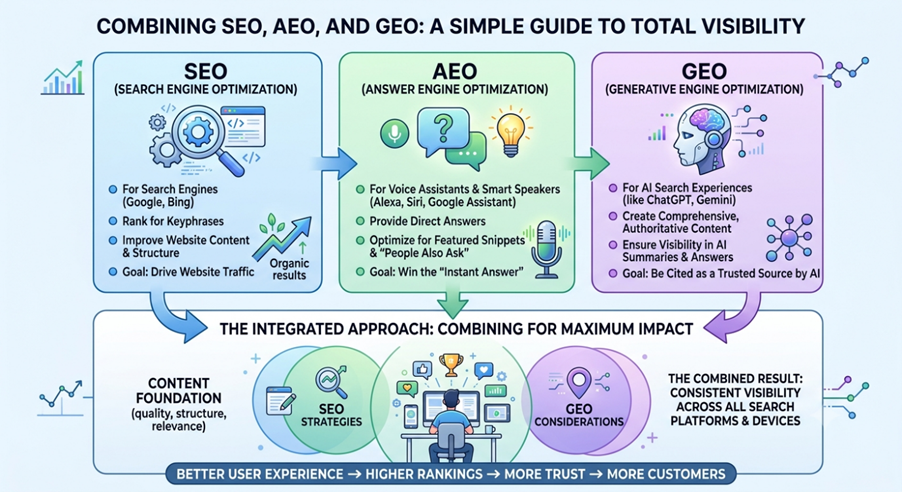
Our strategy does not treat these as three competing campaigns.
Instead, we connect them.
Our integrated model
SEO
Website discovery and technical accessibility
↓
Content Strategy
Topics, keywords, intent, and expertise
↓
AEO
Clear answers to customer questions
↓
GEO
Authority, entity clarity, and broader digital visibility
↓
Conversion Optimization
Leads, inquiries, purchases, or other business goals
↓
ROI Measurement
Performance analysis and continuous improvement
This integrated model helps prevent businesses from constantly switching strategies whenever a new search technology appears.
How Does Our Content Strategy Support Client Growth?
Content is one of the most important components of our approach.
However, we do not believe that publishing a large number of generic articles automatically creates SEO success.
Our content marketing strategy focuses on relevance, usefulness, search intent, and topical depth.
Depending on the client, content may include:
-
- Service pages
-
- Location pages
-
- Educational blogs
-
- Comparison guides
-
- How-to articles
-
- Industry resources
-
- Case-study content
-
- FAQs
-
- Original research
-
- Product guides
-
- Expert commentary
We can then organize these resources into topic clusters.
For example:
Core Service
↓
Supporting Questions
↓
Educational Content
↓
Comparison Content
↓
Industry Resources
↓
Conversion Pages
This structure helps users move naturally from information discovery toward commercial intent.
How Do We Use Competitor Analysis?
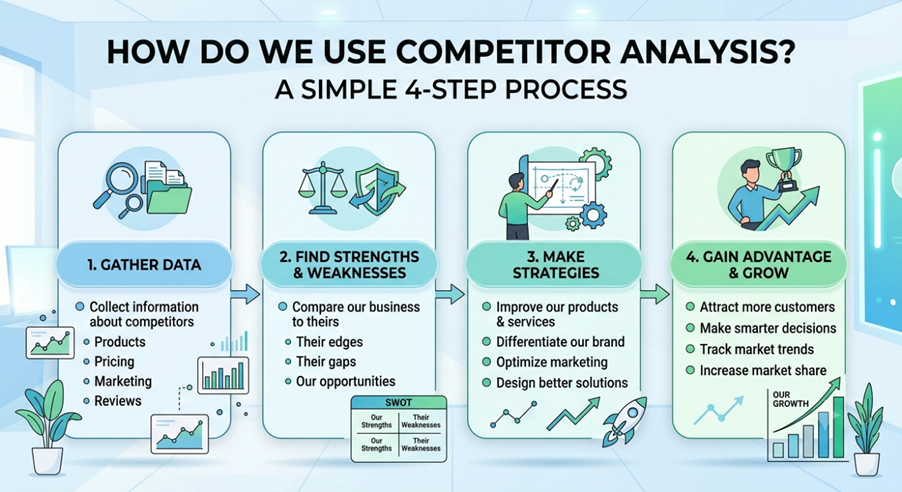
A successful SEO strategy should not operate in isolation.
We analyze the competitive search landscape to understand what competing websites are doing well and where opportunities may exist.
Our competitor analysis can examine:
-
- Keyword targeting
-
- Organic visibility
-
- Content depth
-
- Website structure
-
- Technical performance
-
- Backlink profiles
-
- Local search presence
-
- Service-page optimization
-
- Content gaps
-
- Topic coverage
-
- Search intent
-
- Brand positioning
We do not simply copy competitors.
Instead, we identify opportunities to create more useful, more relevant, or more comprehensive resources.
For example, if competitors have strong service pages but weak educational content, we can build supporting content that addresses unanswered customer questions.
How Do We Build Authority Through SEO?
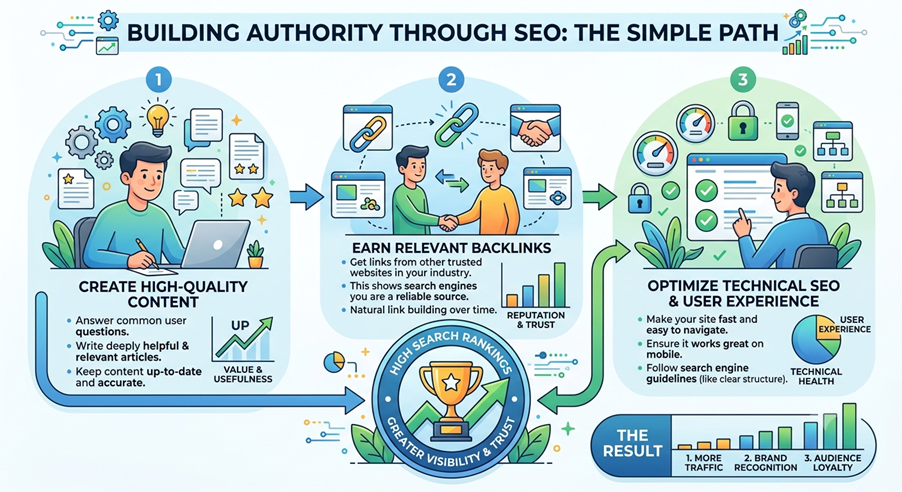
Authority is an important component of sustainable search visibility.
Our approach to link building emphasizes relevance and quality rather than simply pursuing a large number of backlinks.
Depending on the client’s industry, opportunities can include:
-
- Relevant editorial placements
-
- Industry publications
-
- Digital PR
-
- Resource links
-
- Expert contributions
-
- Business citations
-
- Partnerships
-
- Original research
-
- Data-driven content
The objective is to develop a credible digital footprint around the brand.
We also consider whether links are contextually relevant to the website and whether they can contribute to discovery, referral traffic, brand visibility, or authority.
How Do We Use Local SEO for Location-Based Businesses?
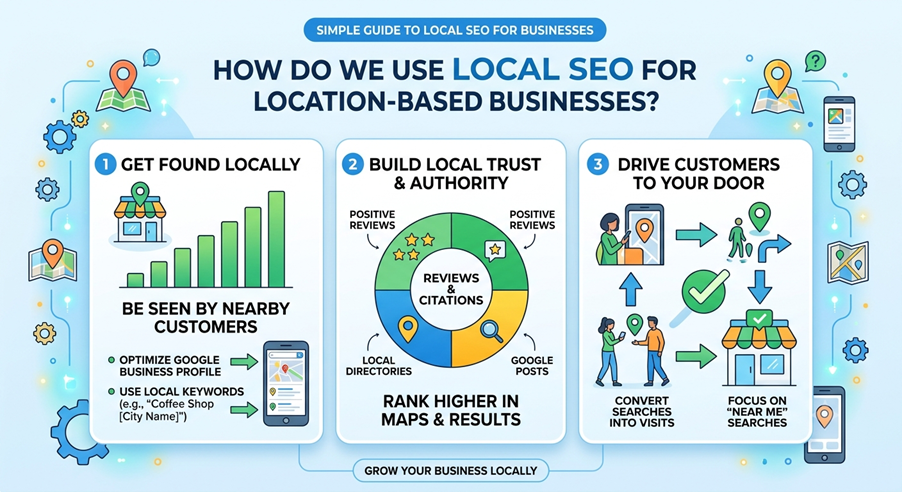
For businesses serving specific cities or regions, local SEO can be a major component of our strategy.
Our local approach can include optimization of:
-
- Location pages
-
- Service-area content
-
- Business information
-
- Google Business Profile
-
- Local citations
-
- Reviews
-
- Local content
-
- Internal links
-
- Local keyword themes
We avoid simply creating dozens of nearly identical location pages.
Instead, the objective is to provide genuinely useful information about the business and the areas it serves.
For a local service company, this can connect search visibility with high-intent queries such as:
“SEO company near me”
“digital marketing agency in [city]”
“web development company in [city]”
The precise keyword strategy depends on the client’s market and customer behavior.
How Do We Optimize Websites for Conversions?
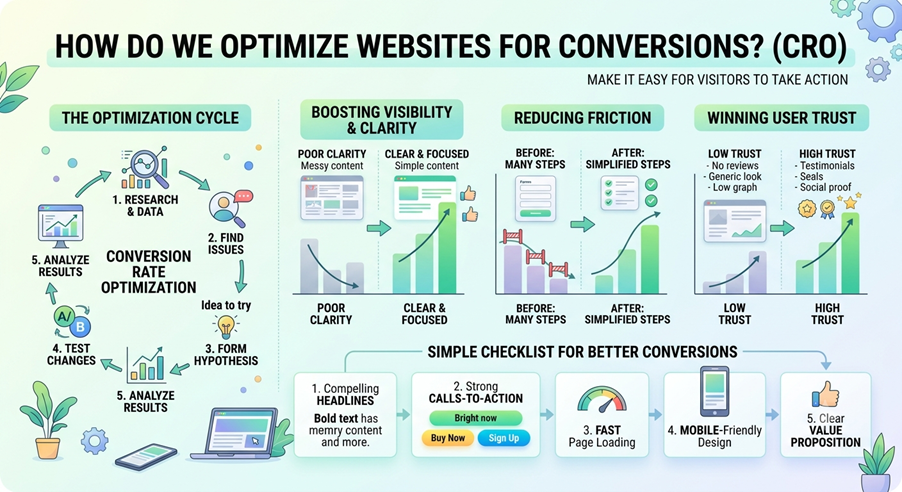
Traffic alone does not equal ROI.
A website can attract thousands of visitors and still produce limited business value if visitors cannot easily understand the offer or take the next step.
Therefore, our strategy connects SEO services with conversion considerations.
Depending on the website, we may evaluate:
-
- Calls to action
-
- Contact forms
-
- Service-page structure
-
- Landing-page messaging
-
- Navigation
-
- Trust signals
-
- Testimonials
-
- Case studies
-
- Contact information
-
- Mobile usability
-
- Page speed
-
- Lead-generation paths
The goal is to make the transition from:
Search → Website → Understanding → Trust → Action
as clear as possible.
How Do We Measure SEO and AI Search Performance?
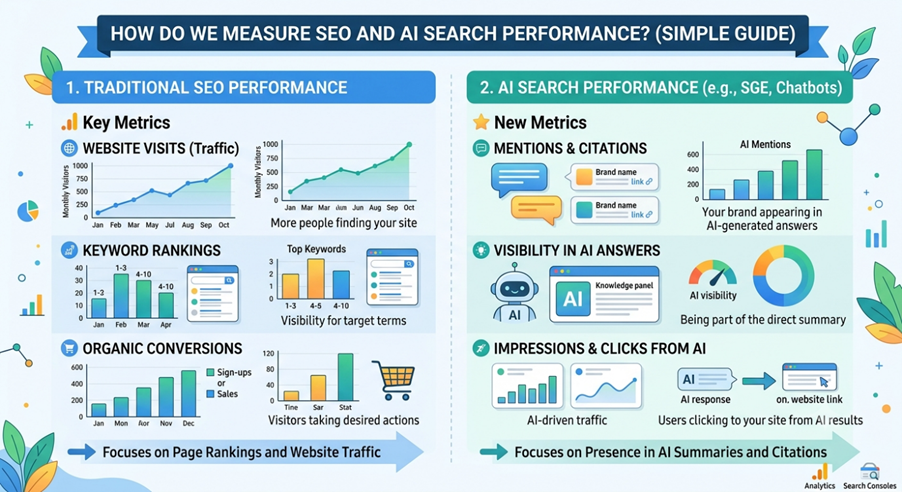
Measurement is essential to our client process.
Rather than focusing exclusively on rankings, we can track multiple levels of performance.
Visibility Metrics
 Organic impressions
 Keyword visibility
 Ranking trends
 AI-search mentions or citations where measurable
Engagement Metrics
🖱 Organic clicks
 Relevant website traffic
⏱ Engagement
 Important landing-page activity
Business Metrics
 Calls
Calls
 Form submissions
 Transactions
 Qualified leads
 Revenue or pipeline contribution
The exact KPIs depend on the client’s business model.
For an e-commerce company, transactions and revenue may be primary.
For a B2B company, qualified leads and pipeline may matter more.
For a local service business, calls and inquiries may be critical.
This is how we connect SEO activity to business outcomes.
How Do We Work Toward Better ROI?
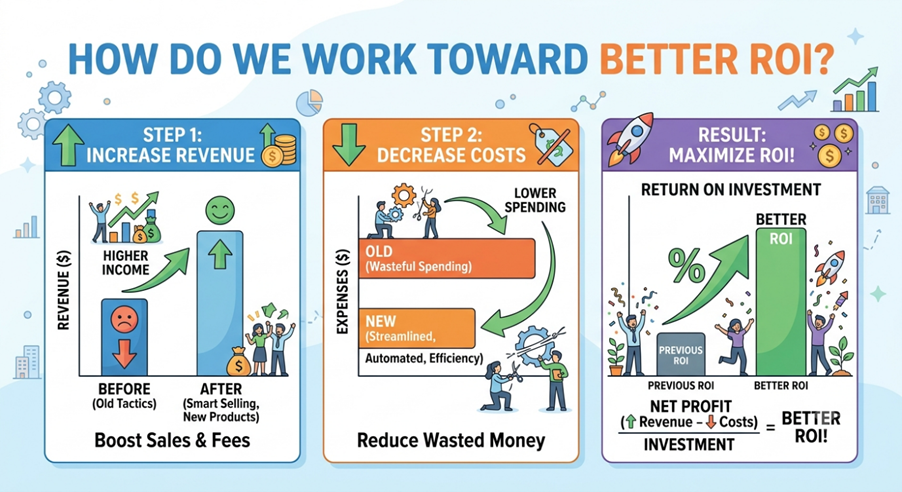
ROI is not created by one SEO task.
It is the result of continuously improving the relationship between marketing investment and business outcomes.
Our process can be represented as:
Research
↓
Prioritization
↓
Implementation
↓
Measurement
↓
Analysis
↓
Optimization
↓
Repeat
For example, if a page receives substantial impressions but generates few clicks, we may investigate its search-result presentation and intent alignment.
If a page receives traffic but produces few conversions, we may examine the landing-page experience.
If a keyword has high commercial value but the website lacks relevant content, we may prioritize a dedicated resource.
This data-led approach helps us decide what should happen next rather than relying entirely on assumptions.
How Do We Use AI Without Sacrificing Content Quality?
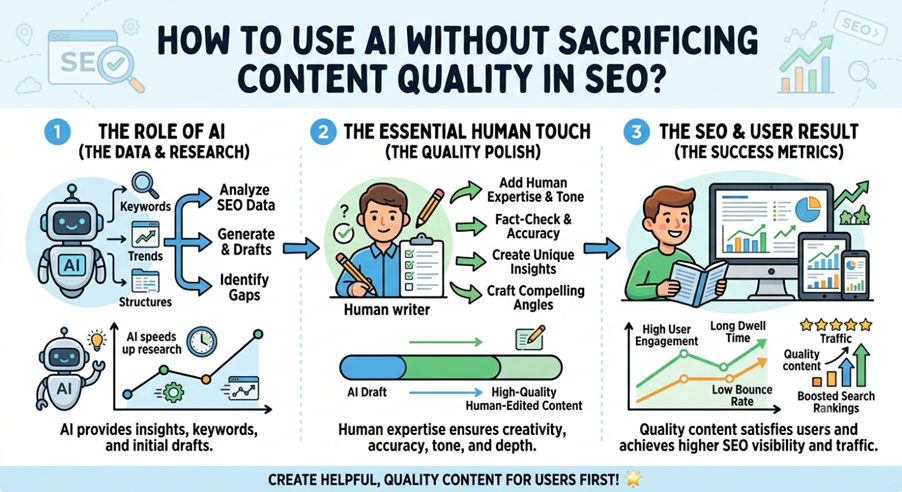
AI has become an important part of modern digital marketing, but we do not treat AI-generated text as a substitute for expertise.
We can use AI-assisted workflows for activities such as:
-
- Topic discovery
-
- Content research
-
- Search-intent analysis
-
- Content outlining
-
- Question discovery
-
- Data organization
-
- Content optimization
-
- Competitive analysis
-
- Workflow automation
Human review remains important.
Content needs to be accurate, useful, relevant, original, and aligned with the client’s expertise.
Google’s guidance for AI search continues to emphasize established SEO practices and useful, people-first content rather than special tactics designed exclusively for AI systems.
Our objective is therefore not:
“Create more AI content.”
It is:
“Use technology to create better marketing outcomes.”
How Do We Create Long-Term SEO Growth?
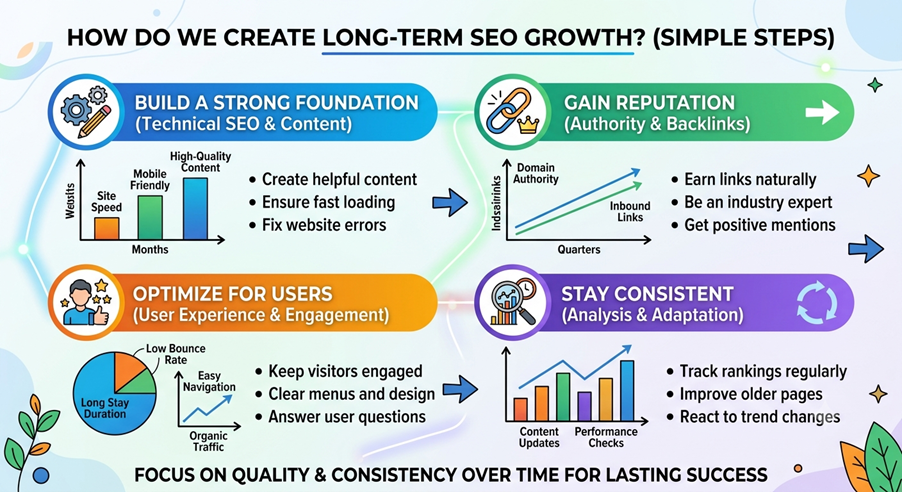
Sustainable SEO requires continuous improvement.
Search behavior changes.
Competitors publish new content.
Search engines evolve.
AI interfaces change.
Customer expectations develop.
Therefore, our client strategy is designed as an ongoing cycle rather than a one-time optimization project.
Month-to-month optimization can include:
Phase 1 — Research
Market, competitors, keywords, technical health, and opportunities.
Phase 2 — Foundation
Technical SEO, architecture, important pages, tracking, and conversion paths.
Phase 3 — Content
Service pages, supporting articles, FAQs, topic clusters, and resources.
Phase 4 — Authority
Relevant mentions, digital PR, partnerships, and link opportunities.
Phase 5 — AEO/GEO
Question-focused content, entity clarity, authoritative resources, and AI-search monitoring.
Phase 6 — Optimization
Analyze results, identify opportunities, improve underperforming assets, and reinvest in activities showing business value.
Why Choose TechnoTronics for SEO, AEO and GEO?
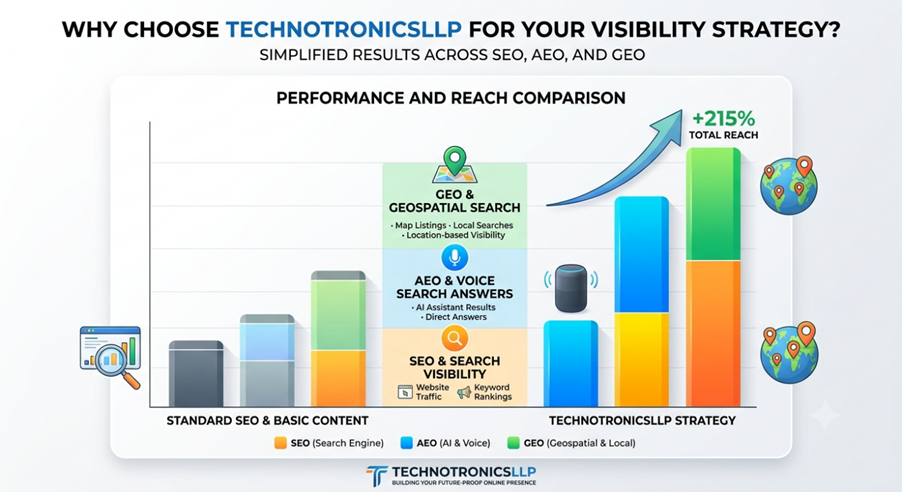
At TechnoTronics, we view modern search marketing as a combination of technology, content, data, and business strategy.
Our approach is designed to connect:
SEO + Technical SEO + Content Marketing + AEO + GEO + Analytics + Conversion Strategy
Instead of promising guaranteed rankings or unrealistic returns, our focus is on building a measurable system that can continuously improve.
For every client, the priorities may be different.
One business may need technical SEO.
Another may need stronger content.
Another may have good rankings but poor conversions.
Another may need local visibility.
Another may need to strengthen its brand presence across emerging AI search experiences.
Our role is to identify those differences and build the strategy accordingly.
What Makes Our ROI Approach Different?
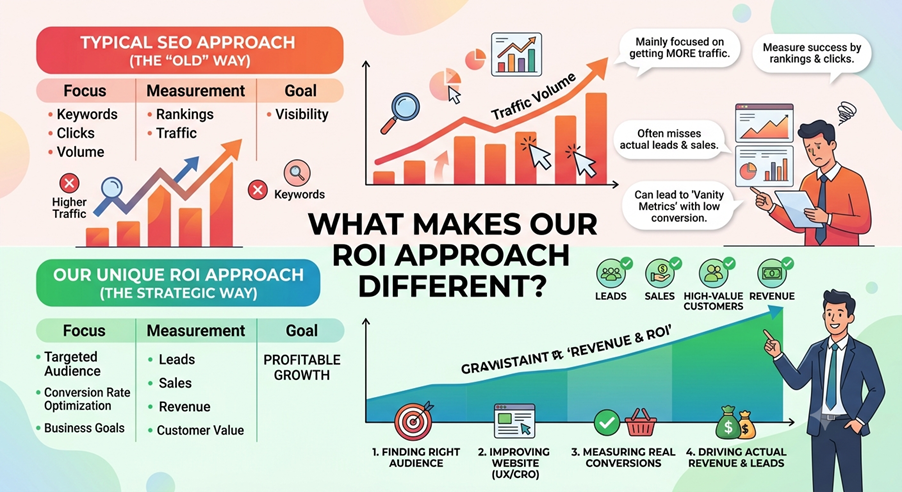
The biggest difference is that we do not define SEO success only by keyword rankings.
Rankings are useful indicators, but business owners ultimately care about business outcomes.
Our framework therefore connects:
Keywords
→
Search Visibility
→
Qualified Traffic
→
Engagement
→
Leads / Sales
→
Revenue
→
ROI
This approach allows SEO decisions to become more closely connected to the client’s actual commercial objectives.
The result is a marketing strategy designed not simply to generate traffic, but to build a stronger and more measurable acquisition channel.
Frequently Asked Questions
Is SEO still important with AI search?
Yes. AI search has changed how information can be discovered and presented, but traditional SEO fundamentals remain important for making websites accessible, understandable, and discoverable.
Does TechnoTronics provide AEO and GEO as separate services?
AEO and GEO can be incorporated into a broader SEO strategy rather than necessarily being treated as isolated campaigns. The exact approach depends on the client’s market, website, objectives, and existing search presence.
Can SEO guarantee ROI?
No legitimate SEO company can guarantee a specific ranking, traffic level, or ROI because search results and customer behavior depend on many external factors. Our approach instead focuses on measurable objectives, ongoing analysis, and optimization.
How long does SEO take to produce results?
The timeframe varies according to competition, website condition, industry, authority, content quality, target market, and implementation speed. SEO should generally be viewed as a continuous growth process rather than an instant advertising channel.
Does TechnoTronics use AI for SEO?
AI can support research, analysis, content workflows, and operational efficiency. However, human oversight, strategic judgment, accuracy, and business relevance remain essential.
What should businesses prioritize first: SEO, AEO, or GEO?
The starting point should normally be a strong SEO foundation. Once technical accessibility, content quality, search intent, and website structure are addressed, AEO and GEO principles can be incorporated into the broader strategy.
Wrapping It Up
The future of search is not simply about choosing between SEO, AEO, and GEO.
It is about building a digital presence that can be discovered, understood, trusted, and acted upon across multiple search environments.
At TechnoTronics, our approach brings these disciplines together:
Technical SEO
Keyword Research
Content Marketing
AEO
GEO
Conversion Optimization
Analytics
=
A Data-Driven Search Growth Strategy
Our objective is to help clients build sustainable digital visibility while keeping business performance at the center of the strategy.
Because ultimately, successful SEO is not just about being found.
It is about being found by the right audience, providing the right information, earning trust, generating qualified opportunities, and creating measurable business value and ROI.